
Test Article BOM in TITAN: Managing the modifications in the Test Article
In complex testing environments, a test article is never static. Whether referred to as a prototype, device under test (DUT) or unit under test (UUT), its configuration evolves continuously from the moment it is conceived and built to the point it is modified, tested and eventually retired. Recognizing and capturing this evolution is critical to ensuring traceability, accurate analysis and confident decision-making.
TITAN’s Test Article Bill of Materials (BOM) capability, introduced in 2025, is designed to do exactly that, track every test article, with full visibility into how its composition changes over time.
In real-world programs, this evolution often happens through multiple planned and unplanned modifications over the lifecycle of the test article. While the concept of “cradle to grave” tracking has always existed, the challenge has been capturing how the BOM itself changes over time and correlating those changes to test events. This gap is what led to the introduction of structured BOM tracking within the test article.
What Is a Test Article in TITAN?
A Bill of Materials (BOM) represents the complete list of parts that make up a test article at any given point in time. Whether the test article is a vehicle, a circuit board or any other product under test, it is ultimately an assembly of components.
In TITAN, each test article is defined by:
- Every test. Every work order. Every issue. One complete history.
- Core attributes (type, identifier, category, etc.)
- A structured BOM listing all its constituent parts
- Manufacturer details and part numbers
- Time-bound configuration states
This creates a living digital record of the test article, not just how it was built initially, but how it changes throughout its lifecycle.
With BOM tracking enabled, modifications to the test article are no longer implicit or assumed. Every change is explicitly captured as part of the test article’s evolving definition.
In the current testing workflow, several challenges hinder efficiency and clarity:
- Fragmented Data Systems: Test article build information and test data reside in separate systems, making it difficult to correlate and analyze test results effectively.
- Limited and Complex Access to Test Article Configuration: Real-time access to test article configuration is neither straightforward nor user-friendly. Additionally, modifying these configurations is a cumbersome process, slowing down test cycles.
- Restricted Access to Configuration Information: Not everyone on the team has access to the test article configuration system, which limits transparency and delays critical decision-making during testing.
Historically, test articles were treated as static entities once created. While the test article itself followed a cradle-to-grave lifecycle, the incremental BOM modifications made during testing were not consistently tracked. This often resulted in gaps when teams attempted to understand what exactly had changed over time.
The primary objective of the project is to streamline these processes by providing clear, immediate visibility into the exact test article configuration used during any specific test. This will enhance traceability, improve communication, and accelerate the overall testing workflow.
Tracking Configuration Changes Over Time
As testing progresses, parts are often replaced due to wear and tear, upgrades, or test-specific requirements. For example:
- A brake component on a test vehicle may be replaced after several months
- The replacement may come from a different manufacturer
- The part number, supplier and installation date change
TITAN captures each of these changes as part of the test article’s history. Every replacement, removal or addition is recorded with context and timing, ensuring that the exact configuration of the test article is always known, past or present.
Each BOM modification in TITAN is time-stamped, creating a precise historical record of when the change occurred, what was modified, and under which context or event.
Flexible Ways to Update BOM Information
TITAN supports multiple ways to manage BOM updates, depending on how teams work:
- Excel import for bulk or offline updates when the latest parts data is already available
- Modification requests to document and approve configuration changes as part of controlled processes
Teams can raise a work order (WO) directly in TITAN to request a BOM modification. The specific parts to be added, removed or replaced can be communicated through TITAN and the assigned owner of the modification WO is fully traceable.
This flexibility allows organizations to align BOM tracking with their existing operational workflows while maintaining consistency and accuracy.
Why BOM History Matters in Testing
Test results don’t exist in isolation; they are directly influenced by the configuration of the test article used at that moment.
Months after a test is completed, teams often need to ask:
- Which test article was used?
- What was its exact configuration at that time?
- Were specific components or manufacturers involved that could have influenced the outcome?
With TITAN’s BOM tracking, teams can rewind to the exact point in time when a test was executed and review the test article’s composition in detail. This makes root cause analysis faster, more reliable and far less dependent on memory or scattered documentation.
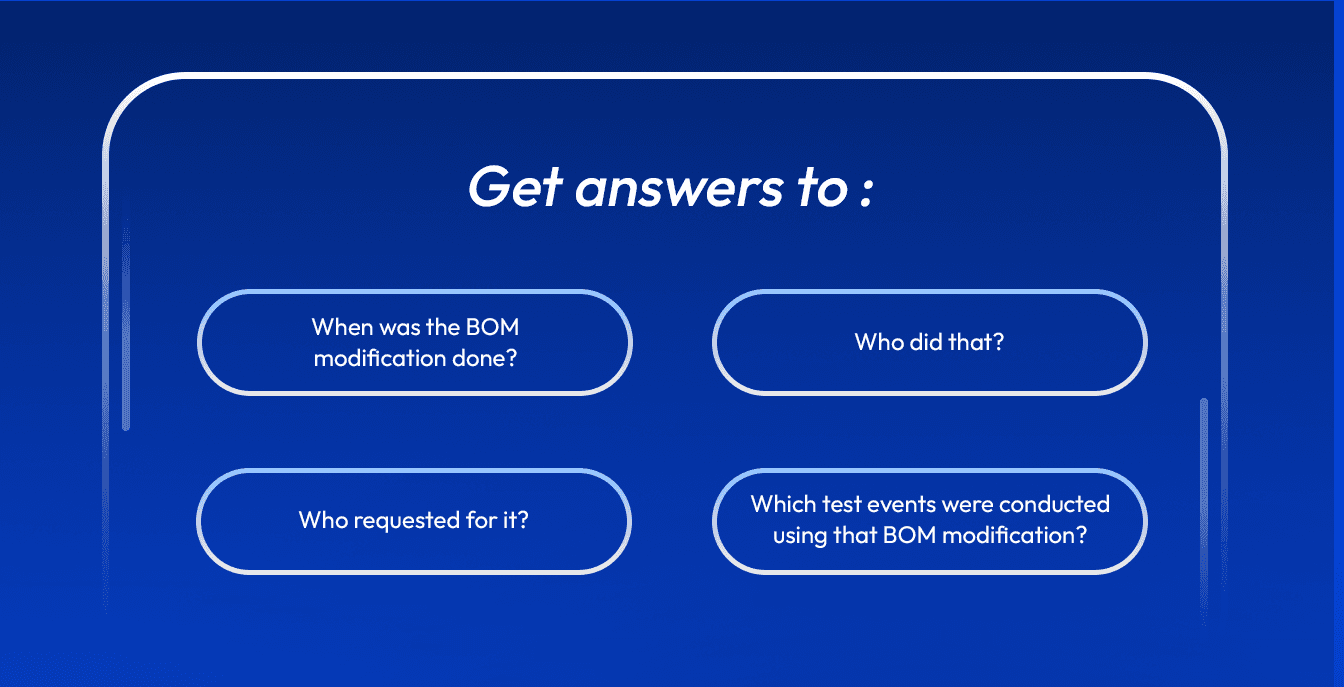
Teams can now clearly answer questions such as: when was a BOM modification done, who performed it, which tests or events were executed using that BOM state, and what part-level changes occurred at each BOM hierarchy.
A Complete Test Article History: In One Place
Beyond BOM changes, TITAN maintains a full historical record for every test article, including:
- Tests performed
- Work orders executed
- Modification requests raised
- Configuration states over time
- Issues that are uncovered
The test article BOM is also linked to parts inventory, enabling visibility into part availability, supplier details and sourcing information directly from the BOM view.
This consolidated history ensures continuity across teams, projects and timelines, even as personnel or priorities change.
The test article BOM is linked to the parts inventory maintained in TITAN. When parts are picked from inventory and added to a test article, their supplier and sourcing details are automatically available as part of the BOM, since this information already exists in the system.
Built for Any Industry, Any Test Article
TITAN’s test article framework is fully customizable. Organizations can define:
- Any type of test article (vehicles, boards, components and more)
- Custom attributes and forms
- Industry-specific structures and hierarchies
No matter what is being tested, TITAN adapts to the product, not the other way around.
Final Reflection
TITAN transforms the BOM from a bulky data dump into an intelligent, living record. Teams can selectively import and track only what matters, update configurations instantly during tests, and maintain a continuously evolving history. This ensures complete clarity and traceability; every result stays connected to the exact product's state at the time of testing.
By introducing time-stamped BOM modifications and tightly linking them to work orders, events, tests and inventory, TITAN closes a long-standing gap in test article lifecycle management.