
A Comprehensive and Systematic Approach to Product Verification
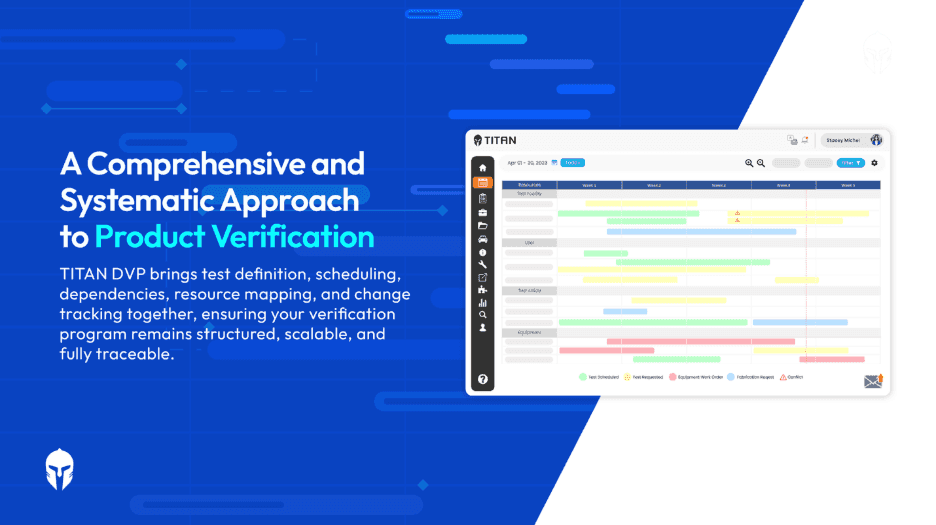
Titan's Design Verification Plan (DVP) combines all elements of test planning, preparation, sequencing, and release into a single cohesive workflow. It ensures that even the most complex and long-running verification and validation programs often spanning months or full product cycles remain structured and trackable.
In Titan, the DVP serves as the central planning layer for a project. When a new product or program launches, the user creates the DVP and sets the timeline. Tests are then added to this plan.
These tests come from Titan’s centralized knowledge repository called the Development Template or think of this as a Test Catalog which contains standardized procedures, parameters, acceptance criteria, and execution guidelines. Instead of building tests from the ground up, users select what they need from this curated library, helping ensure consistency, remove rework, and retain institutional knowledge. As testing practices evolve, the repository evolves with them so that every new project benefits from refined best practices.
Each test within the DVP has its own scheduled window that outlines when it begins, when results are due, and how it aligns with other activities. This structured approach gives teams a clear, unified view of what needs to be tested, when it will occur, and how each step contributes to the broader verification effort.
With Excel and standalone tools, communicating these impacts to different users is convoluted and slow. TITAN eliminates this by notifying all impacted parties automatically through notifications, ensuring no one is left unaware of changes.
1. Comprehensive Test Definition & Setup
A DVP starts with selecting tests from the catalog and configuring all necessary details, including prototypes / samples, resources, facilities, and ownership. Every test is fully contextualized, so teams know exactly what it requires and who will run it.
Track every operation in your testing workflow. TITAN logs who executed which step, who raised issues, who closed them, and all timestamps, ensuring absolute digital transparency and accountability.
When plans evolve, resource allocation information becomes critical. Teams need real time visibility into how changes will impact resource allocation and availability. TITAN provides this directly in the calendar, giving users an immediate view of resource availability as updates occur.
2. Provisional Bookings & Controlled Test Releases
Not every test in a DVP is set for immediate execution. Titan lets you organize this in a natural way:
- Add all planned tests into the DVP
- Mark tests as provisional when their samples / test articles, or inputs are not yet available
- Release only the tests that are ready to run
- Hold the rest until conditions are met
You can roll out tests in stages while keeping the complete DVP definition intact. This way, lengthy verification plans remain adaptable without sacrificing their structure.
3. Bulk Updates for Samples, Facilities & Attributes
DVPs usually have several tests that either use the same sample or need to be conducted at the same facility. Titan simplifies this:
- Select multiple tests at once
- Assign the same prototype or sample to all selected tests
- Route groups of tests to the correct facility
- Apply shared attributes in one action
- This cuts down on repetitive tasks and keeps things consistent across test groups.
4. Dependency Management to Maintain Logical Test Order
A lot of tests can't run on their own; they depend on the successful completion of previous steps. Titan allows you to define and enforce these relationships directly inside the DVP:
- Finish-to-Start (FS) – One test must finish before the next begins
- Finish-to-Finish (FF) – Tests must complete in a controlled sequence
- Start-to-Start (SS) – Tests begin in coordination
- Start-to-Finish (SF) – For uniquely structured sequences
Once dependencies are set up, any changes to the schedule will automatically follow the necessary technical order. The system prevents incorrect test sequences, like trying to do a discharge test before a charge test.
5. A DVP That plans Real Testing Complexity
Genuine verification programs change and grow over time. Samples come in at various stages; dependencies have to be enforced, several tests use the same prototype, and not everything is prepared all at once. Titan’s DVP captures this complexity holistically by supporting:
- Full definition of all planned tests
- Partial releases and controlled execution windows
- Dynamic updates to facilities, samples, and attributes
- Automated enforcement of technical sequencing
- Provisional placeholders for long-term plans
The outcome is a DVP model that evolves alongside the project rather than imposing strict, impractical workflows.
What TITAN’s DVP module does for you
When plans shift, TITAN instantly notifies everyone who needs to know, so changes never catch your team off guard. Every adjustment is tracked with user logs, timestamps, and clear reasons, giving you clear traceability. You get real-time insight into how any change affects resource allocation and availability, helping you stay ahead of conflicts. Plus, every test shows its linked issues right on the screen, so spotting and fixing problems becomes lightning fast.
The payoff is simple.
With TITAN, the information is at their fingertips, and teams do not have to scramble through Excel sheets or manually update and track progress. This creates a clear, streamlined way of working where everyone can access accurate, real-time information without the overhead of manual tracking.