
Digital Transformation of DVP & Test Management Across a Globally Distributed Marine Electronics Operation
A global leader in marine electronics and navigation systems partnered with TITAN to unify its Design Verification Plan (DVP) management, test scheduling and traceability across a four-continent operation. With engineering and test teams distributed across North America, Europe, and Oceania, the organization faced mounting challenges: duplicated test records, no real-time visibility into lab capacity across time zones and a DVP process managed through disconnected spreadsheets and email chains. TITAN was deployed to digitize the full test lifecycle, delivering measurable gains in traceability, scheduling efficiency, and cross-site collaboration within the first six months.
Client Profile
The Challenge
Geographic Fragmentation and Capacity Blindness
Test and validation work was spread across sites in the United States, Europe, and Oceania, each following its own approach to scheduling, equipment records, and test tracking with no common system connecting them. Checking available capacity in another region meant reaching out across time zones, waiting on responses, and piecing together information from local spreadsheets. Equipment sat idle in one region while teams elsewhere waited for access, and resource-sharing decisions were made without a consolidated view.
DVP Traceability Built on Spreadsheets
The DVP sat at the centre of every product programme but was managed in spreadsheets. Engineers across sites maintained their own versions, and updates to tests were not always reflected everywhere. At final review, teams had to manually reconcile the DVP with actual test execution records. Test configurations, acceptance criteria, and past results were stored in individual files. When a similar product entered validation months later, teams often started from scratch, repeating work that had already been done.
No Unified View of Test Requests or Programme Status
Test slot requests came in through emails, messages, and calls with no structured intake, no approval flow, and no single view of active requests across sites. Unplanned maintenance or extended test runs required ad-hoc coordination through more messages and calls. Commercial teams trying to understand where a product stood in its validation cycle had to pull information from multiple sources, often receiving answers that were already out of date.
Calibration and Compliance Tracked in Isolation
Calibration records for environmental chambers, signal generators, EMC equipment, and propulsion rigs were kept in separate, site-specific logs, disconnected from scheduling. Verifying calibration status at the time of equipment assignment relied on manual checks that were sometimes missed, creating audit risks and programme delays.
Solution Overview
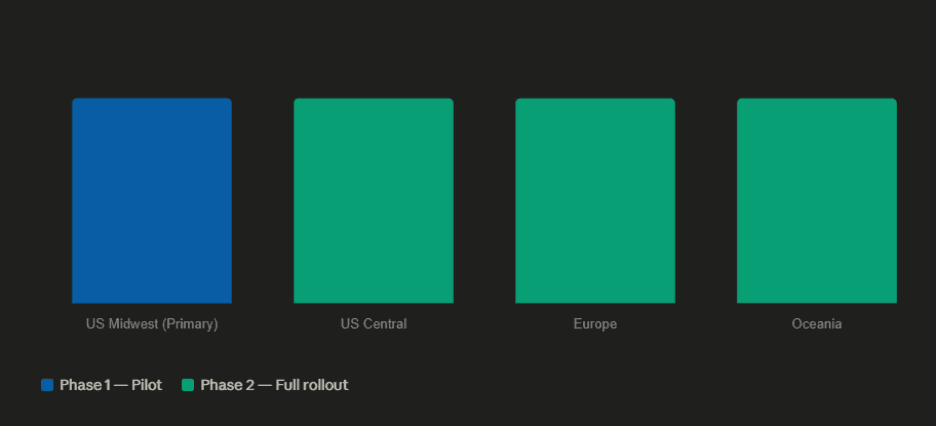
TITAN was implemented in two phases, beginning with a structured pilot at the primary US engineering site before extending across all four locations globally.
Phase 1: Core Deployment — Development Templates, DVP Structure and Test Lifecycle
Development Templates and the Test Catalogue
TITAN's implementation began with the configuration of development templates, the foundation of the entire DVP workflow. For each major product category, including marine control systems, chart plotter electronics, sonar transducers and autopilot units, dedicated templates were built with standard test types, acceptance criteria and sequencing already defined.
Within each template, tests are organized using a folder structure aligned to product subsystems and test domains. For example, all radar-related tests are grouped under a dedicated radar folder. Engineers navigating the DVP can expand the folder to see every test type within it, giving them an immediate, structured view of what is required without needing to build or search for tests individually.
DVP Population — Never Starting from Scratch
When engineers initiate a new programme, they link one or multiple development templates to their DVP. The relevant tests populate automatically from those templates. Engineers are never starting from scratch. From the pre-populated list, they select the tests applicable to their programme and proceed directly into planning and execution.
Where a programme requires a variation of an existing test different parameters, modified acceptance criteria or a changed configuration, engineers can create a version of that test within the DVP. The original test definition is preserved, the version captures the specific modification, and both remain traceable within the programme record. This structure ensures consistency across programmes while giving engineering teams the flexibility to adapt tests where the product or programme demands it.
Structured Test Request and Scheduling Workflow
Test requests moved into a structured workflow, replacing email coordination. Requests were routed through programme managers, equipment coordinators, safety officers and lab leadership before a slot was confirmed. During execution, observations, results and status updates were recorded directly in TITAN against the relevant DVP, giving all stakeholders a consistent, up-to-date view of the programme.
Phase 2: Multi-Site Rollout — Global Visibility, Resource Sharing, Issue Management and Integration
Phase 2 expanded TITAN to the remaining three sites, Wisconsin, Europe, and Oceania with configurations tailored to each location's equipment and availability. KPI dashboards were introduced, giving programme and operations leaders a real-time, consolidated view of equipment utilization, DVP progress and open issues across all four sites.
Specialist equipment such as environmental chambers, EMC benches and propulsion rigs could now be allocated across locations based on available capacity. Scheduling accounted for time zone differences, allowing teams in different regions to plan and work within the same system.
Issue Management
Custom issue management was implemented with severity-based workflows. Issues were categorized into four levels: critical, high, medium and low. Critical and severe issues followed a distinct escalation workflow, with different routing, notification and resolution steps compared to lower-severity issues. This ensured the right level of attention and action was applied based on the impact of the issue on the programme.
Integration with Existing Issue Management Software
TITAN was integrated with the organization's existing issue management software, enabling issues raised in TITAN to flow directly into their established tracking system. This eliminated duplicate data entry, kept engineering and operations teams aligned on open items and maintained a complete audit trail across both platforms.
Results & Impact
DVP Traceability and Data Integrity
- Single, version-controlled DVP record per programme with no parallel spreadsheet versions across sites
- Test configurations, acceptance criteria and historical results retained and searchable across all programmes
- Engineers initiating follow-on programmes start from validated templates, eliminating duplication of prior work
- Full audit trail across every test request, approval, equipment assignment, observation and result available in a single export
Geographic Coordination and Resource Utilization
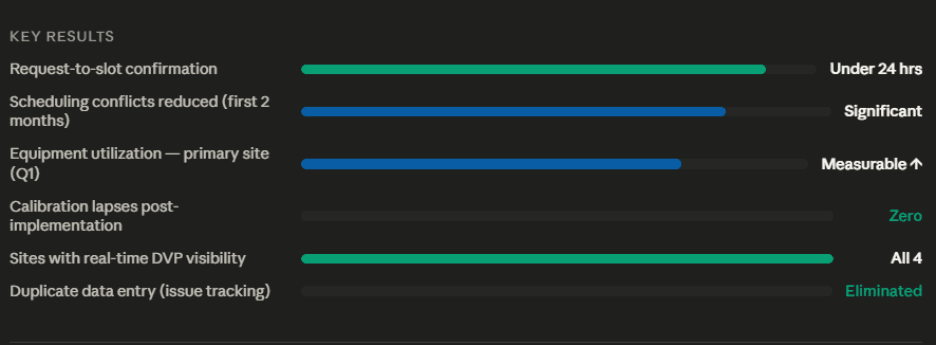
- Cross-site equipment visibility enabled for the first time, programme managers can see real-time chamber and bench availability across all four locations
- Cross-site resource allocation activated for specialist equipment, reducing idle capacity during peak demand periods
- Equipment utilization improved measurably at the primary site within the first quarter post-deployment
- Scheduling conflicts reduced significantly within the first two months of go-live
Test Request and Approval Efficiency
- Request-to-slot confirmation reduced from multiple days to under 24 hours
- Structured intake workflow replaced informal, email-based test requests across all sites
- Programme managers have real-time visibility into test queue status without manual check-ins
Calibration and Compliance
- Zero calibration lapses post-implementation across all equipment categories and all four sites
- Preventive maintenance linked directly to equipment records and scheduling logic; compliance enforced automatically before test execution
- Safety documentation requirements enforced at the point of test assignment
Issue Management
- Custom severity-based workflows deployed; critical issues follow a distinct escalation path from lower-priority items
- Integration with existing issue management software enabled seamless tracking across platforms with no duplicate data entry
To see how TITAN supports marine test operations, book a personalized demo at testlifecycle.com