
Digital Transformation of Battery Test Management
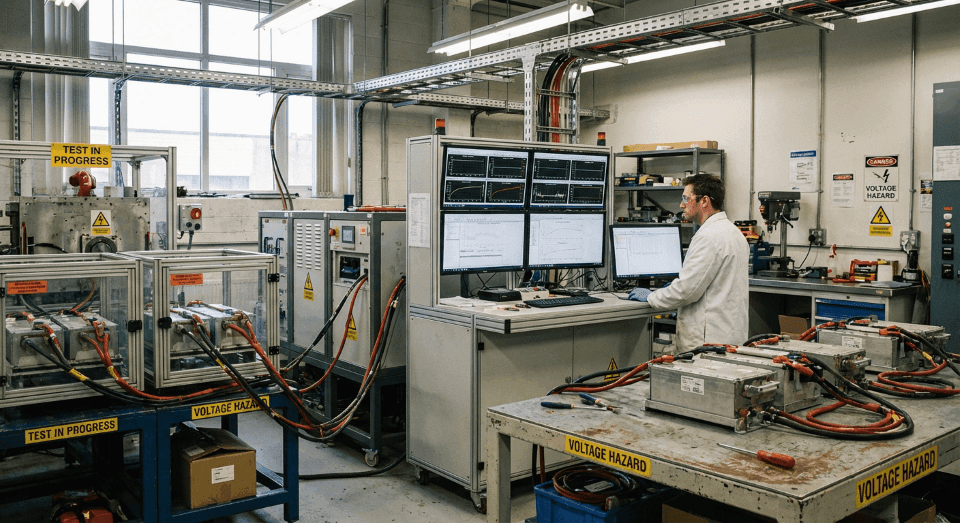
A leading independent battery and high-voltage testing laboratory modernized its test lifecycle management across a multi-site, high-volume operation. Managing concurrent programmes across cell charging and discharging, pack-level capacity testing, thermal characterization, DC IR measurement and short circuit validation with up to 512 cells running in parallel, their existing manual processes could no longer keep up. TITAN was deployed to digitize the full test lifecycle, delivering measurable gains in modular scheduling efficiency, resource utilization and reporting accuracy within the first six months.
Client Profile
| Industry | Battery & High-Voltage Testing - Independent Test Laboratory |
|---|---|
| Headquarters | United Kingdom (Primary Site), with operations across 3 facilities |
| Specialization | Cell and pack-level testing: charging & discharging cycles, battery cycling, thermal characterization, DC IR measurement, internal resistance testing, fault condition monitoring, and EV electronics validation |
| USP | Full-spectrum EV battery and high-voltage systems validation under one roof from cell-level cycling to pack-level thermal and fault condition testing with multi-site capacity for concurrent high-volume programmes |
| Domains Served | Electric Vehicles (EV), Automotive OEMs, Battery Manufacturers, Energy Storage, EV Electronics & Powertrain |
| Equipment Environment | Cell charging & discharging systems, battery cyclers, motor test benches, stator test benches, motor controller test systems, EV electronics testing systems, each requiring individual scheduling, calibration tracking, and data management |
| Scale | 100+ users across 3 sites |
| Timeline | 5 months - phased rollout |
The Challenge
Battery testing is operationally complex in ways that most traditional project management tools simply aren't built for. Tests run continuously, often across multiple shifts. Equipment variety is significant; battery cyclers operate differently from thermal chambers, which operate differently from DC IR measurement benches and motor test rigs. Each has its own calibration schedule, its own setup requirements and its own data output format.
The lab was managing all of this manually. And the cracks were showing.
Scheduling was reactive, not planned. Chamber and bench availability were tracked in shared spreadsheets updated inconsistently across teams. With multiple battery packs testing in parallel across different equipment types: cyclers, charging systems, HV benches, double-bookings were a regular occurrence. When a test overran or equipment went into unplanned maintenance, the knock-on impact had to be managed through phone calls and email chains.
Data compilation was the biggest bottleneck. Observations captured during testing, cell performance statistics, thermal behavior during charge/discharge, CAN interface fault logs and real-time temperature data were recorded across disconnected systems. When it came to reporting, engineers spent days manually compiling data from multiple sources into a coherent document. There was no standardized template, no reusable structure and no single place where test observations lived alongside test results.
Knowledge wasn't retained or reused. Every new test programme essentially started from scratch. , test configurations and historical observations existed in individual engineers' files rather than a shared, accessible system. When a similar programme came in six months later, the team rebuilt what they'd already built, wasting time they didn't have.
Equipment and calibration tracking had no central home. Calibration records for HV measurement equipment, thermocouples, data acquisition systems, and battery cyclers were maintained in separate logs with no connection to the scheduling layer, creating both compliance risk and operational blind spots.
Solution Overview
TITAN was implemented in two phases, beginning with a pilot at the primary facility before expanding across all three sites.
Phase 1 — Core Deployment
TITAN's modular architecture was configured to reflect the lab's equipment environment with chamber-level and equipment-level scheduling built separately but connected within the same platform. Each equipment category, battery cyclers, charging and discharging systems, thermal chambers, motor benches was set up as a distinct schedulable resource with its own calibration tracking, availability logic and maintenance workflow.
A structured test request and approval workflow replaced email-based coordination, routing requests through account managers, safety officers, equipment coordinators, and lab management before any slot was confirmed.
Critically, TITAN's test catalog and development template functionality was configured to capture and standardize the lab's existing test knowledge. For common test types, charge/discharge cycles, DC IR measurement, constant current testing, thermal monitoring runs, reusable templates were built, allowing engineers to initiate a new programme from a validated baseline rather than starting from a blank page.
Observations captured during test execution: cell performance data, fault conditions, temperature behaviour, statistical performance monitoring were logged directly within TITAN against the relevant test record, eliminating the separate observation logs that had made reporting so time-consuming.
Phase 2 — Multi-Site Rollout
Phase 2 extended TITAN across the remaining two sites with location-specific configurations. KPI dashboards were activated, giving lab leadership a consolidated view of equipment utilization, programme progress and open issues across all three locations. Cross-site resource sharing was enabled for battery cyclers and specialist equipment; a capability that had previously been unmanageable without a connected system.
Results & Impact
Scheduling & Coordination
- Scheduling conflicts reduced by over 90% within the first two months
- Equipment-level and chamber-level scheduling connected for the first time cyclers, HV benches, thermal chambers and motor test rigs all visible in one platform
- Test request-to-slot confirmation time cut from 3–4 days to under 24 hours
Reporting & Data Compilation
- Reporting effort reduced by approximately 45%; observations captured within TITAN during execution, eliminating the post-test data hunt
- Standardized report templates generated directly from test records, replacing manual document assembly
- Full audit trail across every test request, approval, equipment assignment, and result available in a single export
Knowledge Reuse & Work Efficiency
- Development templates built for recurring test types charge/discharge, cycling, DC IR, thermal characterization significantly reducing programme setup time
- Engineers no longer rebuilding test configurations from scratch for similar programmes
- Historical observations retained within the system and accessible for future programme reference
Equipment & Compliance
- Zero calibration lapses post-implementation across all equipment categories
- Preventive maintenance linked directly to equipment records and scheduling logic
- Safety documentation compliance enforced automatically before test execution
Resource Utilization
- Chamber and bench utilization improved by 28% at the primary site in the first quarter post-deployment
- Cross-site battery cycler allocation activated, reducing idle capacity during peak demand periods
- First-time visibility into planned versus actual test hours across all equipment types
Return on Investment — At a Glance
Within six months of deployment, TITAN delivered a measurable, quantifiable impact across every critical area of lab operations.
| Area | Result |
|---|---|
| Scheduling conflict reduction | Up to 90%+ |
| Reporting time saved | Up to ~45% |
| Request-to-slot confirmation | From 3–4 days → under 24 hours |
| Equipment utilization improvement | Up to 28% (primary site, Q1) |
| Calibration lapses post-go-live | Zero |
| Programme setup time | Significantly reduced via reusable templates |
| Cross-site resource visibility | Enabled for the first time |
| Compliance enforcement | Automated — pre-execution safety checks |
To see how TITAN supports battery and HV test facilities, book a personalized demo at testlifecycle.com